 Navi protocol
Protocol Borrow Limits as Collateral Values Change
Protocol borrowing capacity moves as oracle prices revalue enabled collateral and outstanding debt. In NAVI Protocol, a lower collateral value reduces available capacity and can weaken the health factor, while a higher debt-asset value has a similar effect. Check the live position before changing either side.
On this page
Collateral value, asset parameters and usable capacity
Usable borrowing capacity connects three account states: enabled collateral, asset-specific risk parameters and existing debt. NAVI Protocol values each qualifying collateral asset through its oracle price, then applies the relevant LTV for the selected market and EMode setting. The combined amount forms an account-level ceiling for new debt. Supplied assets outside the collateral calculation do not add to that ceiling.
Outstanding debt occupies part of the ceiling after its own oracle conversion. Available capacity is therefore the difference between the weighted collateral limit and the value of existing debt, subject to reserve controls. A wallet balance or total supplied value alone cannot reveal this number because different assets may carry different parameters or collateral status.
What changes when collateral loses value?
A collateral price decline reduces the value supporting the loan as soon as the protocol recognizes the updated oracle state. The account can lose unused borrowing capacity without supplying, borrowing or withdrawing anything. If the decline consumes all remaining headroom, a new borrow request can exceed the account limit even though the collateral quantity has not changed.
The same price movement also affects position safety through the liquidation threshold. The same price movement affects both borrowing capacity and liquidation exposure, but they are not interchangeable measurements. One governs how much additional debt may be opened. The other determines how close existing debt is to liquidation eligibility.
LTV and the ceiling for new debt
Loan-to-value, commonly shortened to LTV, sets the collateral contribution used for new borrowing. Each enabled asset contributes its oracle value multiplied by its applicable LTV. An account holding several collateral assets receives a weighted limit across them. Live reserve data matters because replacing one asset with another can change capacity even when the total market value appears unchanged.
Liquidation thresholds and the health factor
The liquidation threshold belongs to the safety calculation for debt already open. NAVI Protocol compares threshold-weighted collateral value with the total value of outstanding debt. The resulting health factor changes when collateral prices move, borrowed assets move in price or interest increases the debt balance.
A NAVI Protocol position becomes eligible for liquidation when its health factor falls below 1.
Liquidation eligibility does not mean every unit of collateral disappears at once. The applicable reserve settings govern how much debt a liquidator may repay and how collateral is transferred in return. Those settings are separate from the LTV used to approve a new loan, so an account can have no room for another borrow while remaining above the liquidation boundary.
Debt prices and accrued interest
Debt valuation forms the other side of the health calculation. If a borrowed asset rises against the unit used by the oracle, the account's debt value grows even when the token amount stays unchanged. That increase consumes borrowing headroom and lowers the health factor. A declining collateral price and a rising debt price can therefore reinforce each other.
Accrued interest also raises the amount owed over time. The effect may be gradual, but a position already near its limit has less room to absorb it. Multiple borrowed assets are evaluated together, so only a decline in their combined oracle value reduces the debt side of the calculation.
Reserve conditions beyond account collateral
Reserve state can restrict a borrow even when account-level capacity remains positive. The chosen asset must be available for borrowing, the reserve must have enough unborrowed liquidity and its borrow cap must have room. A pause or an oracle validation problem can also prevent execution. These conditions belong to the selected reserve rather than the borrower's collateral balance.
A displayed maximum should therefore be treated as a state-dependent estimate. Between preview and execution, a price update, interest accrual, another user's activity or a reserve configuration change may alter the executable amount. The transaction also needs a valid Sui gas payment or sponsorship before it can be processed.
Four stages from preflight to reconciliation
A bounded borrow workflow checks the prerequisite state before creating debt, preserves a reversible stop before submission and reads the resulting position afterward. Each stage uses the same Sui account and selected debt asset. Only the transaction result and refreshed position confirm execution.
| Stage | Asset and position state |
|---|---|
| Preflight | Read enabled collateral, debt values, oracle state and reserve availability for the Sui account. |
| Amount selection | Keep the requested debt asset within account capacity, reserve liquidity and remaining cap. |
| Execution | Review and submit the Sui transaction only while its asset, amount and account still match the intended change. |
| Reconciliation | Confirm the transaction result, updated debt, remaining capacity and health factor across the position. |
| Verified end state | The recorded debt and refreshed risk measurements agree with the completed Sui transaction. |
A missing prerequisite should stop the process before submission. If the reserve no longer has enough liquidity or the live limit has fallen below the requested amount, reducing or abandoning the request leaves the existing on-chain position unchanged. After execution, the refreshed account state determines the next decision.
The last reversible point
The commitment boundary is submission of a signed transaction capable of opening debt. Before approval and submission, changing the requested amount does not alter the on-chain balance. At this reversible point, compare the proposed debt with remaining capacity and the projected health factor.
The transaction contents should identify the expected account, borrowed asset and amount. An unexpected additional action changes the meaning of the approval and deserves a fresh review.
The projected position should retain room between its health factor and the liquidation boundary. Using every displayed unit of borrowing power leaves ordinary price changes and accrued interest with no visible buffer.
Gas payment is a separate prerequisite from collateral capacity. A valid position can still fail to execute when the transaction lacks an acceptable gas payment or sponsorship.
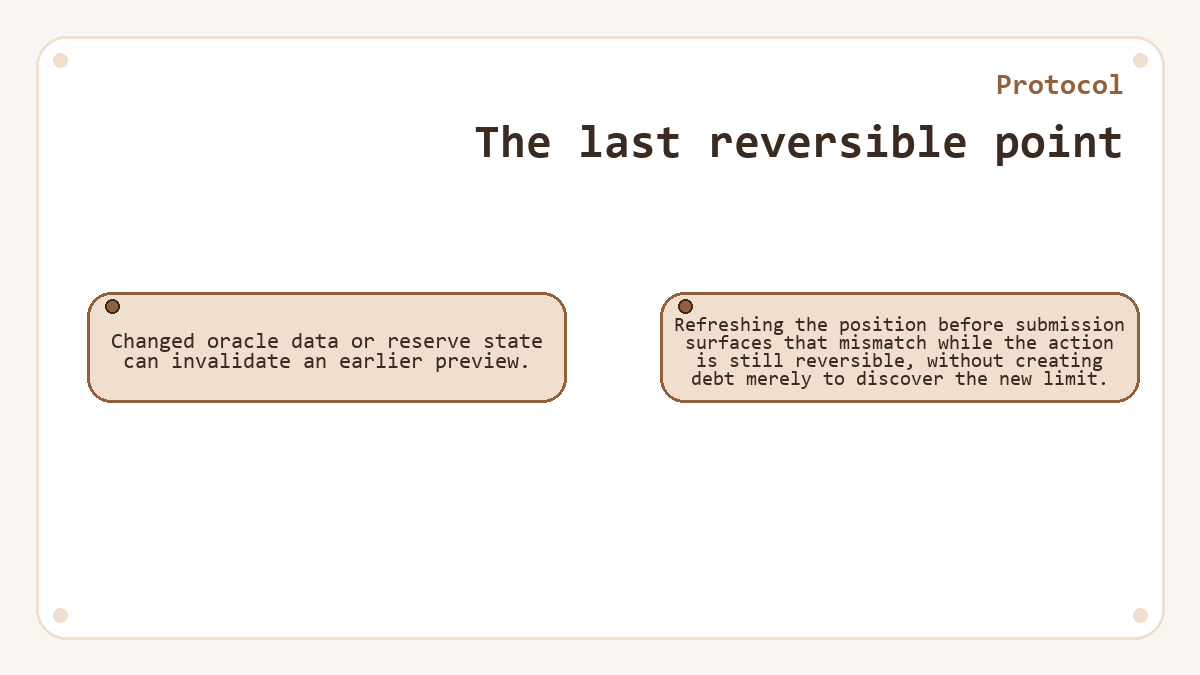
Changed oracle data or reserve state can invalidate an earlier preview. Refreshing the position before submission surfaces that mismatch while the action is still reversible, without creating debt merely to discover the new limit.
Transaction and position reconciliation
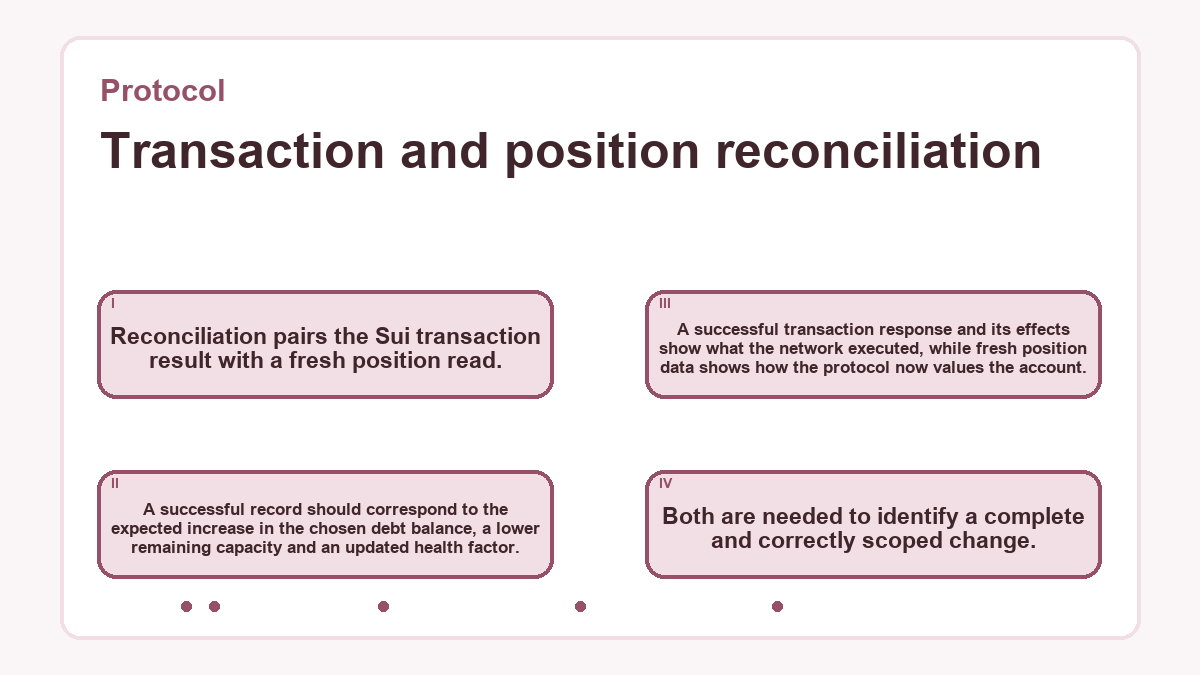
Reconciliation pairs the Sui transaction result with a fresh position read. A successful record should correspond to the expected increase in the chosen debt balance, a lower remaining capacity and an updated health factor. A successful transaction response and its effects show what the network executed, while fresh position data shows how the protocol now values the account. Both are needed to identify a complete and correctly scoped change.
How can borrowing capacity be rebuilt?
Borrowing capacity can be rebuilt by reducing debt or increasing eligible collateral, while favorable price movement may also expand it. Repayment lowers the debt side once the transaction is recorded. Supplying more only affects the limit if the asset qualifies as collateral and is enabled for that use in the relevant position.
A partial repayment can improve both available capacity and the health factor without closing the loan. Full repayment removes the selected debt only after accrued interest and principal are settled in the recorded state. Withdrawing collateral moves the calculation in the opposite direction and may be restricted when the remaining position would not satisfy protocol limits.
Monitoring capacity as prices diverge
Ongoing monitoring should compare collateral value, total debt, remaining capacity and health factor as one position. Watching collateral alone misses increases in borrowed-asset value and interest. Watching the health factor alone does not show whether a new borrow is blocked by a reserve cap or limited pool liquidity.
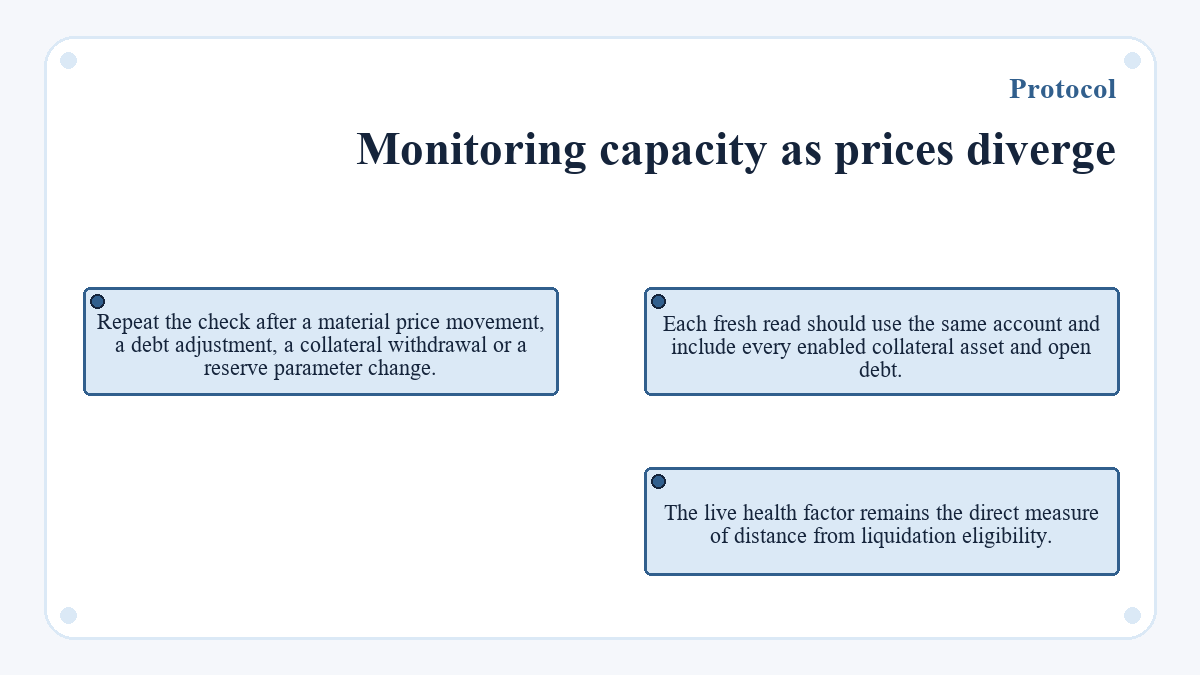
Repeat the check after a material price movement, a debt adjustment, a collateral withdrawal or a reserve parameter change. Each fresh read should use the same account and include every enabled collateral asset and open debt. The live health factor remains the direct measure of distance from liquidation eligibility.
Details worth knowing about Protocol
-
Can a supplied asset add nothing to NAVI borrowing capacity?
- Yes. A supplied asset can add no borrowing capacity when it is not eligible for collateral or is not enabled as collateral for the position. Supply value and collateral value are therefore different account measurements. The asset may still remain supplied, but the borrowing calculation only includes balances admitted under the applicable collateral settings.
-
Why can a small collateral price move remove most remaining headroom?
- A small price move can consume a large share of headroom when existing debt already occupies most of the weighted collateral limit. Headroom is the difference between the limit and debt, not the full collateral value. Once that difference is narrow, even a modest revaluation or additional interest can reduce it sharply.
-
Is available borrowing power the same as withdrawable collateral?
- No. Available borrowing power estimates how much additional debt the weighted collateral may support, while withdrawable collateral concerns removing a supplied balance. A withdrawal must also respect the safety of any remaining debt and the reserve's available liquidity. The two amounts can therefore differ even when they are calculated from the same position.
-
Does a failed borrow request change the existing debt?
- A failed borrow request should not create the proposed debt. The existing position still needs a fresh read because prices, interest or reserve state may have changed during the attempt. A transaction failure also does not prove the account lacks collateral capacity; liquidity, caps, oracle validation and gas conditions can block execution separately.
-
How much repayment ends current liquidation eligibility?
- The amount needed to end current liquidation eligibility is enough to move the recorded health factor above 1 after repayment. This may be a partial repayment, but any remaining debt can become eligible again if prices or interest move against the position. Because those values can change before execution, verify the post-transaction debt balance and health factor.
Updated ·