 Navi protocol
 Lets Users Supply, Borrow and Manage Positions on Sui
Navi protocol is a Sui liquidity protocol for supplying supported crypto assets, earning variable interest and borrowing against eligible collateral. Deposits enter asset-specific pools used to fund loans, while collateral parameters limit each account's borrowing capacity. A borrower manages the resulting debt by watching the health factor, repaying when needed and preserving enough collateral to avoid liquidation. Suppliers can withdraw when the pool has enough unborrowed liquidity and the withdrawal does not make an active loan unsafe.
Supply, borrowing, repayment and withdrawal
Four core actions define a lending position, although an account does not need to use all four. Supply places an eligible asset into its pool. Borrow draws another supported asset against enabled collateral. Repay returns principal plus accrued interest. Withdraw redeems a supplied balance, subject to pool liquidity and any active debt.
- Supply: Add an asset to its lending pool and receive the accounting token for that deposit.
- Borrow: Draw from a supported pool within the account's available borrowing power.
- Repay: Reduce or close debt using the same asset owed by the position.
- Withdraw: Redeem supplied assets when liquidity and account health permit the change.
Each action changes a different part of the account. A supply balance can earn variable interest without creating debt. Borrowing adds an obligation whose balance grows with interest. Repayment reduces debt, while withdrawal reduces the assets supporting the account.
Pools, receipt tokens and collateral
Asset-specific pools connect suppliers with borrowers. Supplying an asset deposits it into a shared pool, while the protocol issues a receipt token representing the supplied balance. That token is part of the protocol's accounting for the deposit and is redeemed when the underlying asset is withdrawn.
Collateral is a role assigned to an eligible supply position, not a second deposit. Once enabled, its oracle value contributes to borrowing capacity under the asset's loan-to-value setting. The borrowed asset moves to the user's Sui address, while the corresponding debt remains recorded against the lending account. Price feeds let the protocol compare different assets on a common value basis.
Borrowing capacity before commitment
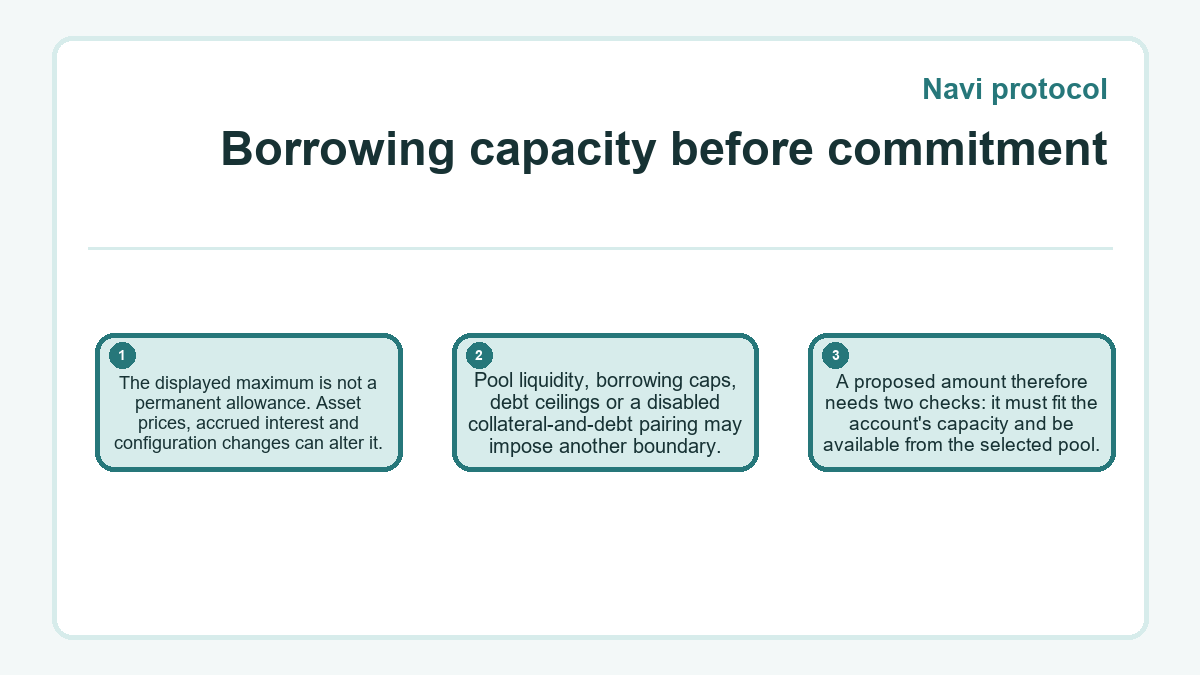
Available borrowing power is the live ceiling to inspect before authorizing debt. Its calculation starts with the oracle value of eligible collateral and applies each asset's configured loan-to-value ratio. Existing debt consumes part of that capacity, so a wallet balance alone does not reveal how much the account can borrow.
The displayed maximum is not a permanent allowance. Asset prices, accrued interest and configuration changes can alter it. Pool liquidity, borrowing caps, debt ceilings or a disabled collateral-and-debt pairing may impose another boundary. A proposed amount therefore needs two checks: it must fit the account's capacity and be available from the selected pool.
A supply or debt balance changes only when the signed Sui transaction executes successfully. Before signing, compare the asset and amount with the intended position, then inspect the projected health factor through available account data or simulation. A successful transaction record confirms execution; an unsigned preview does not create a supply or debt balance.
How does the health factor move?
The health factor rises when risk-adjusted collateral grows relative to debt and falls when that relationship worsens. Collateral prices, debt-asset prices, accrued interest, repayment, new borrowing and withdrawals can all move it. The liquidation threshold used in this calculation can differ from the loan-to-value ratio used to set borrowing capacity.
A health factor below 1 makes a lending account eligible for liquidation. A value above 1 indicates the account remains above that boundary at the prices and parameters then in use. It does not freeze those inputs. A concentrated position can move quickly if either side of the loan changes value.
No single buffer suits every position. The relevant margin depends on asset volatility, collateral concentration and how quickly the account holder can repay or add eligible collateral. Monitoring matters after confirmation because both market prices and interest can change without another transaction from the borrower.
A borrow request above the live limit
All figures in this example are hypothetical account-value units, not live protocol settings, and the arithmetic excludes any live borrowing fee. Suppose eligible collateral is worth 137 units and its displayed loan-to-value ratio is 62%. The arithmetic capacity is 84.94 units. With 52.3 units already borrowed, the remaining capacity is 32.64 units before pool-specific limits.
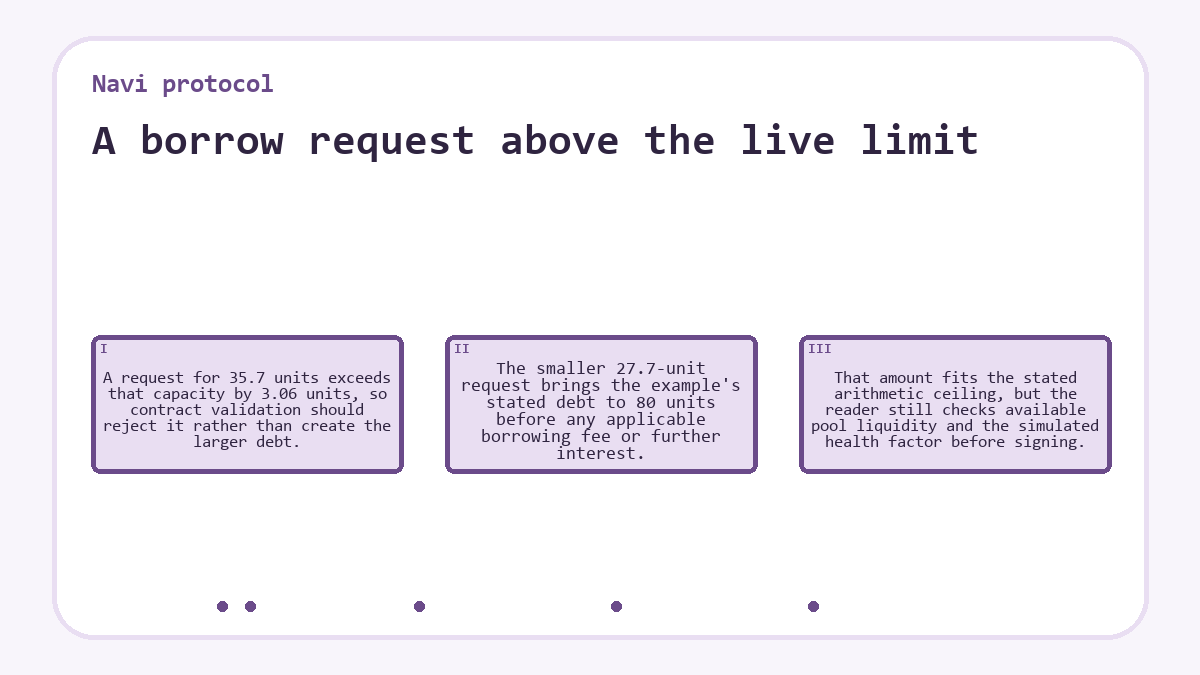
A request for 35.7 units exceeds that capacity by 3.06 units, so contract validation should reject it rather than create the larger debt. The smaller 27.7-unit request brings the example's stated debt to 80 units before any applicable borrowing fee or further interest. That amount fits the stated arithmetic ceiling, but the reader still checks available pool liquidity and the simulated health factor before signing.
After confirmation, verify the successful Sui transaction and updated debt balance against the hypothetical 80-unit calculation, any borrowing fee and accrued interest shown before signing. If the live loan-to-value ratio or oracle values change before execution, the 84.94-unit ceiling must be recalculated. The formula stays the same, but its inputs reflect live conditions.
Utilization and changing interest rates
Pool utilization links borrowing demand with the rates shown to suppliers and borrowers. Utilization for an asset equals its total borrowed amount divided by the sum of available cash and the total borrowed amount. A pool with more of its liquidity borrowed has less cash immediately available for withdrawals.
The interest model uses live pool state and configured rate factors rather than promising one permanent APY. Supplier earnings come from interest paid by borrowers, adjusted through the pool model. Borrowers accrue interest on outstanding debt. Any applicable borrowing fee is a separate live charge. Any separate incentive rewards should be evaluated apart from the base supply or borrow rate because incentives can follow another schedule.
Rate changes affect both sides at different times. A higher borrow rate increases the pace at which debt accrues, while a changing supply rate alters expected earnings. Neither displayed annualized rate fixes the amount ultimately earned or paid. The position balance and current rate provide the relevant state.
Repayment and collateral release
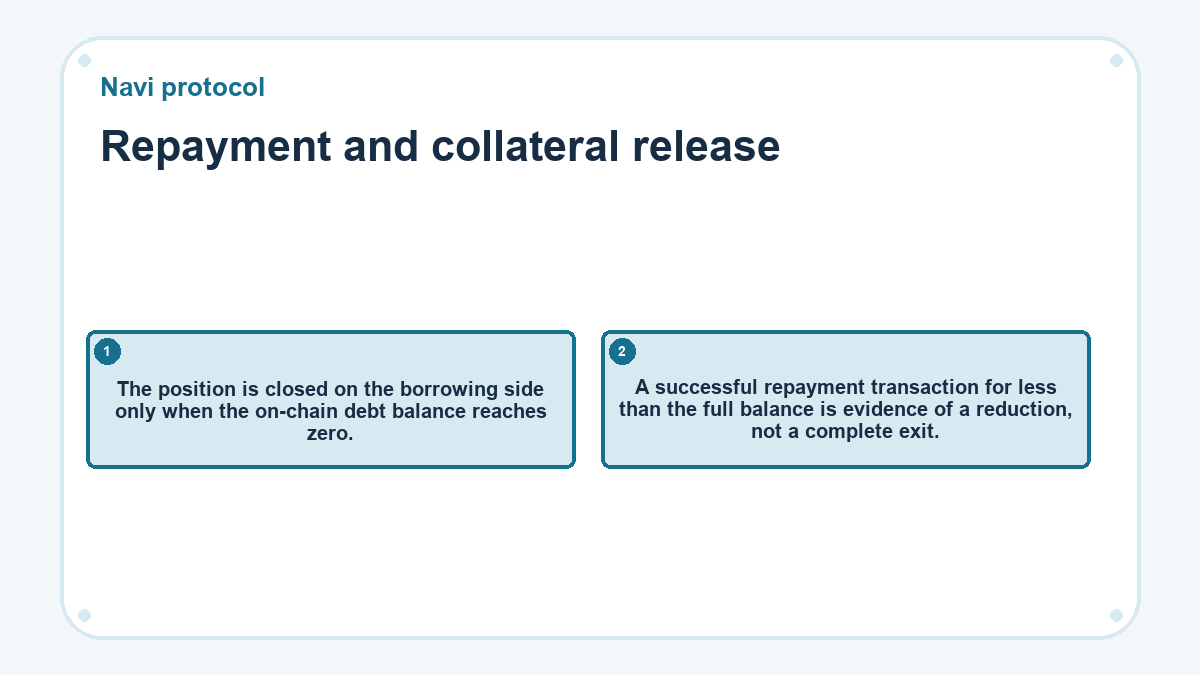
Repayment reduces outstanding principal and usually improves the health factor when other inputs stay unchanged. A partial repayment leaves a smaller debt balance. A full close requires the amount currently owed, including interest accrued since the last recorded balance, so an earlier snapshot may be slightly lower than the execution amount.
Repaid capacity does not itself withdraw collateral. It removes debt and can make more of the supplied balance eligible for withdrawal. If some debt remains, the proposed withdrawal must still preserve the required collateral relationship. Repaying first is often the clearest way to reduce risk, but it is not mandatory when the remaining position stays within its limits.
The position is closed on the borrowing side only when the on-chain debt balance reaches zero. A successful repayment transaction for less than the full balance is evidence of a reduction, not a complete exit.
Withdrawal liquidity and account limits
Withdrawal depends on both the account and the pool. The account must remain healthy after collateral leaves, and the pool must hold enough unborrowed liquidity to return the requested asset. High utilization can therefore prevent an immediate full withdrawal even when the supplier owns the recorded balance.
Redeeming a deposit burns or reduces the corresponding receipt-token balance and returns underlying assets. A failed withdrawal does not erase the supply position. It means a live condition blocked that request, such as insufficient pool cash or the effect on collateralization. The withdrawable amount may change when borrowers repay, suppliers add liquidity or the account reduces debt.
Supply caps govern what a pool can accept, while withdrawal availability reflects cash presently left in the pool. These are different constraints. Neither should be inferred from an advertised rate.
Liquidation and reserve controls
Liquidation is the protocol response to an undercollateralized borrowing account. Liquidators can repay debt for that account and receive collateral with the configured liquidation incentive. The borrower loses part of the collateral, while the repaid portion reduces debt. This mechanism is permissionless rather than an optional repayment service for the borrower.
Reserve-level controls shape the exposure before liquidation occurs. Supply caps limit how much of an asset enters a market. Borrow limits constrain account debt, debt ceilings restrict exposure backed by certain collateral and pair restrictions can prevent one collateral asset from supporting a particular borrowed asset. A paused state can stop funding operations until the relevant control changes.
These controls reduce specified pool risks but do not remove price, oracle, liquidity or smart-contract risk. Liquidation depends on the health calculation and live prices. A position above the threshold can later cross it when collateral falls, borrowed assets rise or interest expands the debt.
Transaction records and a clean exit
On-chain records distinguish an intended action from a completed one. Lending operations emit records for deposits, withdrawals, borrows and repayments. A successful transaction digest identifies the executed Sui transaction, while account data shows how the resulting supply, debt and health values changed.
A clean borrowing exit means the debt balance is zero. A clean supply exit means the intended receipt-token balance has been redeemed and the underlying asset appears at the chosen recipient address. Those states are separate, so closing debt does not automatically withdraw a deposit. Likewise, withdrawing an unencumbered supply position does not create a repayment record.
Final review should use the same Sui address and market involved in the operation. If the interface is temporarily stale, the transaction status and on-chain account state remain the stronger evidence. If debt remains, repay the balance; if liquidity is unavailable, wait or reduce the request; if the prior transaction failed, resolve its error before retrying.
Good to know
Is there a minimum amount to supply through NAVI protocol?
NAVI does not set a fixed per-transaction supply minimum or maximum. A live market can still have a pool-wide supply cap, and a transaction must be large enough to make sense after Sui network fees. Token precision also limits the smallest representable amount. Check the selected pool's current cap and the wallet's transaction details before authorizing a deposit.
Can I supply assets without opening a loan?
Yes, supplying does not require borrowing. The deposited asset can earn the pool's variable supply rate while the account carries no lending debt. Borrowing is a separate action and requires eligible collateral plus available capacity. A supply-only position still depends on smart contracts and available pool liquidity for withdrawal, but it has no borrower debt accumulating interest.
Does supplying alone expose a position to liquidation?
No borrowing debt means there is no undercollateralized loan for a liquidator to repay. Liquidation concerns accounts with debt whose health factor falls below 1. The supplied asset can still change in market value, and withdrawal may depend on unborrowed pool liquidity. Those are different risks from losing collateral through a lending liquidation.
Are all supported assets eligible as collateral?
No, support for supplying an asset does not automatically make it eligible collateral for every loan. Each reserve has configuration governing collateral use, loan-to-value limits and liquidation parameters. Pair restrictions or a debt ceiling can narrow what one asset supports. Read the live market configuration for the exact supply asset and intended debt asset before treating a deposit as borrowing power.
How is EMode different from an ordinary borrowing position?
EMode, or Efficiency Mode, groups configured assets into categories with lending parameters designed for that category. It can permit a higher loan-to-value ratio than an ordinary position, but only for eligible assets and markets. Entering EMode does not remove health-factor monitoring or liquidation risk. The applicable category, caps and parameters must come from the live market configuration.
Why are flash loans separate from regular borrowing?
A flash loan accesses pool liquidity within one Sui transaction. The borrowed amount plus fees must be repaid in that transaction, or a debt position must be opened when the pool permits that route. Regular borrowing persists across transactions, accrues interest and is bounded by collateral, borrowing power and health-factor rules.
Can lending rewards differ from the base supply interest?
Yes, base supply interest and incentive rewards are separate components. Base interest comes from borrower activity and the pool's utilization-based rate model. A reward program can add another token or rate under its own conditions, and that program can change or end. Evaluate the live base rate without assuming a displayed incentive will continue for the life of the deposit.
How are Sui network fees paid for lending transactions?
Sui transactions consume gas paid in SUI, including supply, borrow, repay and withdrawal operations. A wallet therefore needs enough SUI outside the amount committed to complete the transaction. The fee is a network execution cost, not the pool's supply or borrow interest rate. Its exact amount depends on the transaction and the network conditions at execution.
Updated ·